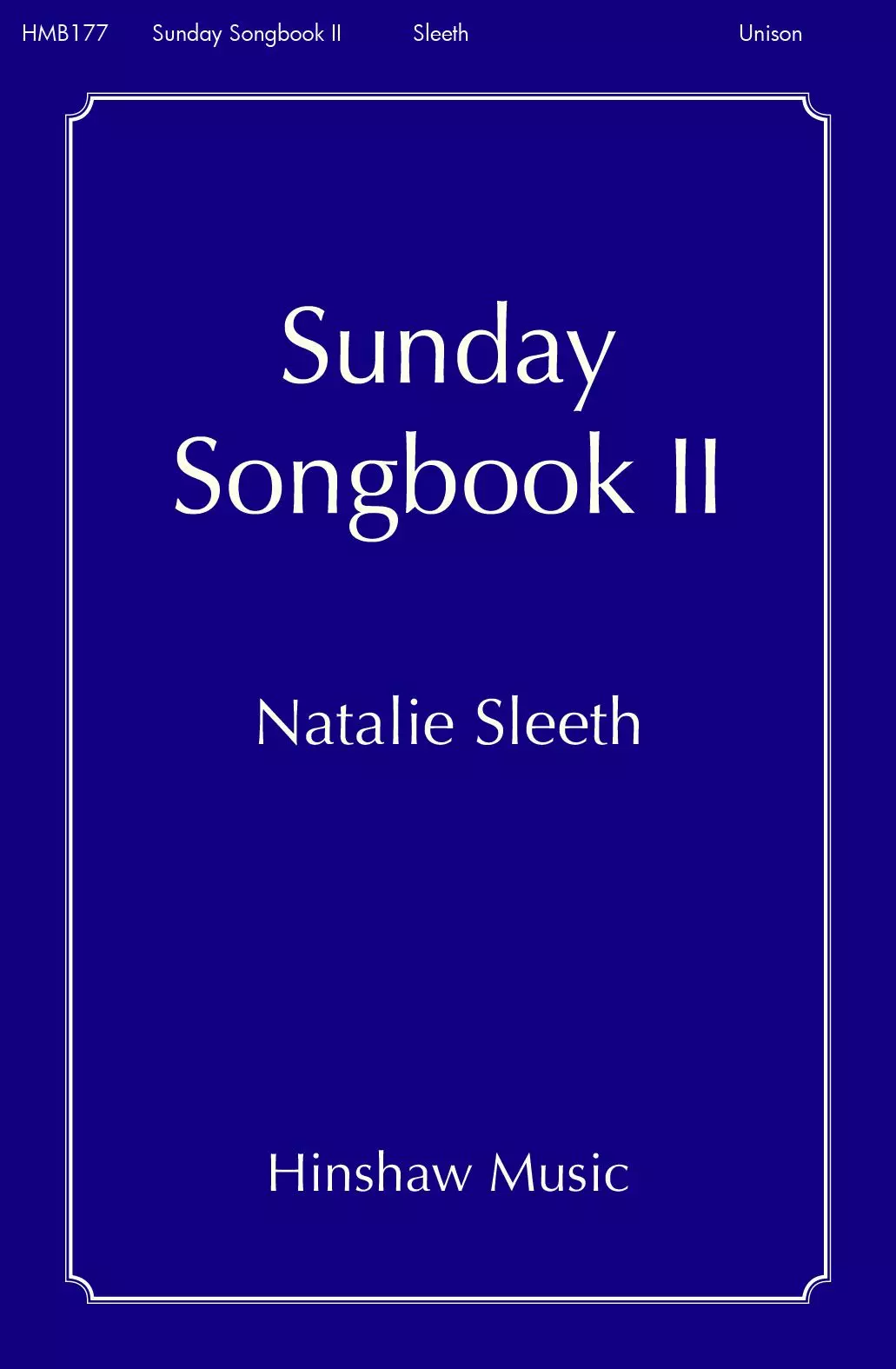
Sunday Songbook II – Unison
$5.50
Description
Book two of the popular collection. Twelve more unison, optional second part, pieces. Highly recommended.
Contents:
1. Fear Not For Tomorrow.
2. Let’s Sing About God’s Love.
3. Each New Day.
4. How We Goin’ To Praise The Lord?
5. Welcome To The Fam’ly Of God.
6. All Around The Whole Wide World.
7. Never Forget To Be Thankful.
8. P-E-N-T-E-C-O-S-T.
9. Christ Arose! Halleluiah!
10. Pass It Along.
11. I Wish I’d Been In Bethlehem.
12. He Comes!
SCORE SPOTLIGHT: SUNDAY SONGBOOK II
A Church Year in Singable Form
Some collections are useful because they provide a group of songs.
Sunday Songbook II is useful because it provides a shape.
Natalie Sleeth’s collection is built around the rhythm of Christian worship and formation. Across twelve unison songs, the volume moves through the church year and through the life of faith: expectation, incarnation, witness, resurrection, Spirit, gratitude, communion, baptism, praise, trust, stewardship, and love.
That breadth is what gives the collection its lasting value.
Sunday Songbook II is not merely a book of seasonal pieces. It is a practical teaching resource for churches. It gives choirs, children, worship leaders, and congregations a way to sing the major themes of Christian faith in language that is direct, memorable, and musically approachable.
The cover identifies the volume as “a collection of unison songs for any age,” and that phrase matters. The collection is not limited to a single ensemble type. It can serve children’s choirs, intergenerational groups, Sunday school programs, smaller church choirs, or any worship setting where clarity, accessibility, and theological usefulness matter.
Natalie Sleeth understood something essential about church music: a melody can become a teacher.
When words are meaningful and melodies are singable, singers remember more than a tune. They remember ideas. They remember images. They remember the shape of faith.
That is the heart of Sunday Songbook II.
Songs That Teach the Calendar of Faith
The collection begins with He Comes!, marked for Advent or Palm Sunday. That dual use is one of the first signs of the collection’s practicality. The song can serve two different moments in the Christian year because it focuses on arrival, expectation, and the coming of the Lord.
From there, I Wish I’d Been in Bethlehem turns toward Christmas. The song gives singers a way to imagine the Nativity not as a distant event, but as something they might have wanted to witness. That imaginative quality makes the Christmas story approachable, especially for younger singers.
Pass It Along! is marked for Epiphany, and its placement is important. Epiphany is not only about light or revelation. It is also about witness. The song’s title captures the movement of faith outward. What has been received is meant to be shared.
Christ Arose! Hallelujah! gives the Easter portion of the collection a clear sense of celebration. It is direct, bright, and suitable for singers who need an Easter song that is both joyful and accessible.
P-E-N-T-E-C-O-S-T! brings a playful and educational energy to Pentecost. The title itself suggests that the song is designed not only to celebrate the day, but to help singers learn and remember it. For many churches, Pentecost can be one of the more difficult seasons to program for children’s or unison choirs. This piece gives that part of the church year a practical musical entry point.
Together, these songs show one of the collection’s central strengths: it helps churches teach the calendar of faith through music.
Faith Beyond the Major Seasons
The second half of the collection broadens beyond the major liturgical seasons into core themes of Christian living.
Never Forget to Be Thankful is marked for Thanksgiving or thanks. It gives singers a way to name gratitude as part of faith, not merely as a seasonal sentiment.
All Around the World is marked for Worldwide Communion. This is especially valuable because music for Worldwide Communion often needs to communicate unity, fellowship, and the global nature of the church in a way that is accessible to a broad congregation. A unison song on this theme can help younger singers participate meaningfully in a service that points beyond the local congregation.
Welcome to the Family of God! is marked for Baptism. This is one of the most practically useful songs in the collection. Baptism services often benefit from music that is warm, welcoming, and congregationally understandable. A unison song centered on belonging and welcome gives the church a way to celebrate baptism without requiring complex musical forces.
How’re We Goin’ to Praise the Lord? brings energy and immediacy to the theme of praise. The title feels conversational and invites participation. This is the kind of song that can help singers understand praise not as a formal religious idea, but as something embodied in voice, action, joy, and community.
Fear Not for Tomorrow is marked for Trust. Its presence in the collection gives balance to the more celebratory songs. The Christian life includes joy and praise, but it also includes uncertainty, fear, and the need for assurance. A song of trust gives singers language for those moments.
Each New Day is marked for Stewardship. This is another practical and thoughtful inclusion. Stewardship is often reduced to money or obligation, but the song places the theme within daily life. Each new day becomes something received and something to be used faithfully.
Let’s Sing About God’s Love closes the collection with one of the broadest and most central Christian themes. God’s love becomes not only a doctrine to be named, but a reason to sing.
A Collection for Formation, Not Just Performance
The most important thing to understand about Sunday Songbook II is that its purpose is not limited to performance.
This is formation repertoire.
The songs are designed to be sung, but they are also designed to teach. Their value is found in how they help singers internalize faith through repeated musical experience.
This makes the collection especially useful for children’s choirs and church school settings, but it also makes it valuable for intergenerational worship. Because the songs are unison, the musical barrier is low. Because the texts are purposeful, the spiritual and educational value remains high.
That combination is not accidental.
Natalie Sleeth’s writing has long been valued because it respects both the singer and the listener. Her music is accessible, but it is not empty. It is approachable, but it is not careless. Sunday Songbook II shows that same gift across a wide range of themes.
The result is a collection that can serve churches repeatedly.
A director might use one song in Advent, another at Christmas, another at Easter, another for Pentecost, another during a baptism service, and another during a stewardship emphasis. Over time, the book becomes more than a collection. It becomes a musical companion to the church year.
Why Directors Will Appreciate This Collection
Directors will appreciate Sunday Songbook II because it solves several practical problems at once.
First, it offers usable unison music for multiple seasons and occasions. Rather than searching for separate pieces for Advent, Christmas, Easter, Pentecost, Thanksgiving, Baptism, and other themes, directors have a single volume that covers a wide range of worship needs.
Second, the music is accessible. The unison format makes the songs approachable for younger singers, developing choirs, smaller programs, and intergenerational groups.
Third, the collection is educational. Each song gives directors an opportunity to teach something about the church year or Christian life. The songs are not merely “special music.” They can become part of a larger formation process.
Fourth, the language is direct and singable. These songs are built to be understood. That matters in church contexts where singers may be children, new choir members, or congregants encountering a theme for the first time.
Finally, the collection gives worship planners flexibility. A song can be chosen for a specific Sunday, a seasonal program, a children’s choir presentation, or a congregational moment.
Sunday Songbook II is the kind of resource that becomes more valuable the longer a church owns it.
The Gift of Singable Theology
The phrase “singable theology” helps describe what makes this collection distinctive.
Theology can be taught in sermons, classes, books, and conversations. But in church life, theology is also taught through the songs people remember.
Sunday Songbook II gives churches a way to teach faith musically.
It teaches that Christ comes.
It teaches that Christmas is a wonder to be imagined and celebrated.
It teaches that the story of faith is meant to be shared.
It teaches resurrection joy.
It teaches Pentecost as the beginning of the church’s Spirit-filled witness.
It teaches gratitude.
It teaches communion as a sign of worldwide fellowship.
It teaches baptism as welcome into the family of God.
It teaches praise as active and joyful.
It teaches trust in the face of tomorrow.
It teaches stewardship as the faithful use of each new day.
It teaches that God’s love is lasting and worth singing about.
That is more than a list of songs.
That is a curriculum of worship.
A Collection with Long-Term Use
Some pieces are programmed once and then set aside.
Sunday Songbook II is different.
Because it covers so many seasons and themes, the collection has long-term practical use. A church does not need to exhaust it in one season. It can return to the book throughout the year, selecting songs as the worship calendar and educational needs unfold.
This makes the volume especially valuable for churches with limited rehearsal time or limited choral forces. It gives directors music that can be learned efficiently while still contributing meaningfully to worship.
The collection also has value for churches rebuilding children’s music programs or strengthening intergenerational participation. Because the songs are unison and designed for any age, they allow participation without requiring advanced choral training.
That accessibility is not a weakness.
It is part of the collection’s purpose.
Sunday Songbook II reminds us that simple music can carry deep meaning when it is carefully written, thoughtfully organized, and rooted in the life of worship.
A Practical Resource with a Pastoral Purpose
At its best, church music does more than fill a moment in a service.
It forms memory.
It shapes belief.
It gives language to faith.
It helps singers participate in the story of God.
Sunday Songbook II does exactly that.
Through twelve unison songs, Natalie Sleeth gives churches a practical and pastoral resource for singing the major seasons and themes of Christian life. The collection is accessible enough for children and flexible enough for intergenerational worship, yet meaningful enough to remain useful across repeated use.
Its strength lies in its clarity.
Each song knows what it is for.
Each song gives singers something important to carry.
Together, they form a collection that helps the church sing its calendar, its worship, and its faith.
Why This Collection Matters
Sunday Songbook II matters because it gives churches a complete, accessible, and theologically purposeful resource for singing the Christian year.
The collection is especially valuable because it does not separate worship from learning. Each song helps singers participate in worship while also teaching a season, doctrine, or spiritual practice. Through unison writing, singable melodies, and clear texts, Natalie Sleeth creates music that can be used by singers of many ages and experience levels.
For children’s choirs, the collection provides meaningful songs that are not musically overwhelming.
For church music directors, it provides practical repertoire for recurring worship needs.
For congregations, it offers music that helps the community remember and celebrate the story of faith.
Sunday Songbook II is a strong example of repertoire that is simple without being shallow, useful without being disposable, and educational without losing its worshipful character.
Additional information
| Catalog # | HMB177 |
|---|---|
| Voicing | |
| Composers | |
| Arrangers | |
| Authors | |
| Accompaniment | |
| Instrumentation | |
| Release Date | |
| Content | |
| Season | |
| Difficulty | |
| Publisher | |
| Status |